The weight of our decisions: designing isn't simple
A habit of intentional design is the gravity point of building trust for what's new. Humanist design is the gravity point of real loyalty.

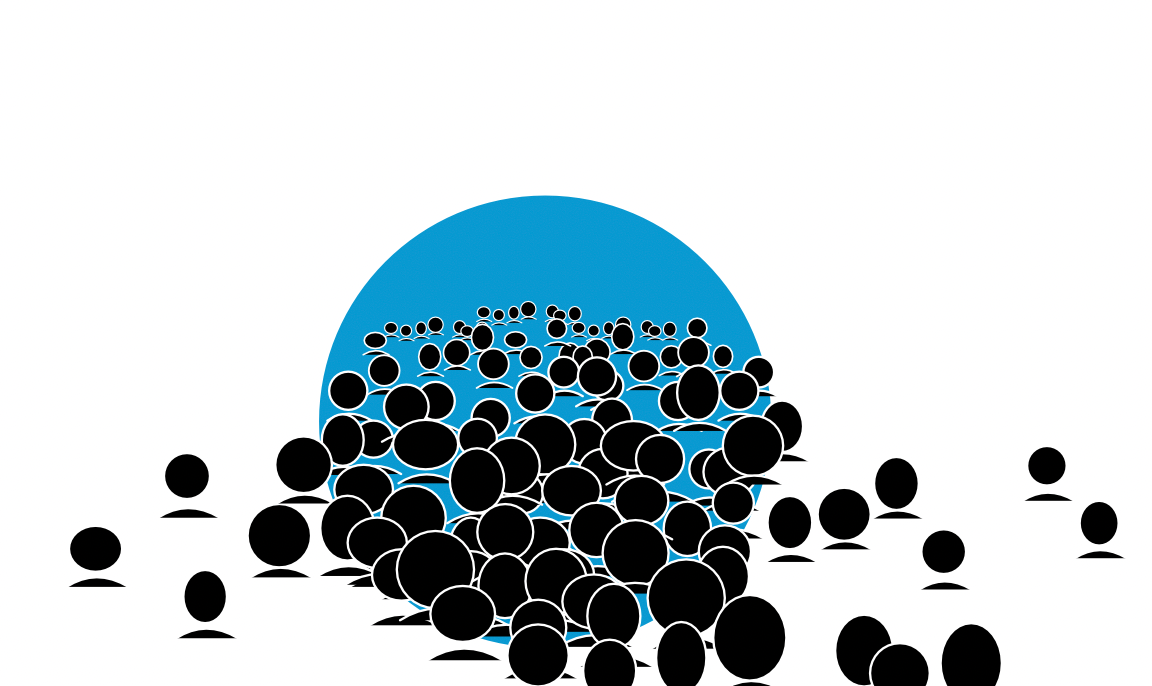
People are incredibly diverse
Individual agency exists even if we don’t program for it; but as we document data and feed more of it through our information technology, where we don’t support agency becomes an ersatz morality police that most of us don’t even intend. Most of it is simply the quick regurgitation of how one or a handful of people have figured out their path through a problem set, and then spent their time trying to get it programmed. We're predicating the entire information support on (usually) one useful path found, when to truly understand a problem set in context usually has multiple ways to successfully get through it.
The reality is that the fewer people who were involved in the testing and figuring out of the process, the more likely it’s a finite slice of potential rather than a composite. The problems are twofold: the process' ability to reflect reality, and the willingness of people to run with outputs when they don’t understand the contextual ramifications of the process. Small, finite processes mostly don’t do too badly — or fail so blatantly that they are hot-fixed. Complex processes are more prone to automation bias, in turn leading to all kinds of pervasive algorithmic problems.
People are variable: in what they see as the solution, in how they design for and around it, and in how they consume provided solutions.
In some spaces, people just want to get shit done, and the simple option is all they want: screw agency. In other spaces, people feel the oppression of having their who-ness diminished or outright removed.
Those spaces often overlap. They can nest. They can be exactly the same spaces in every respect, but that one person feels it like a dirty job done quickly and reasonably painlessly, and one person feels it like the weight of an authoritarian boot. It can even be the same person at different points in time. Wherever two extremes like that exist, it almost always is a spectrum node: extremes defining the edges, with a potentially infinite number of variations between. Often it will be defined as a binary, scoped to include a business-defined relevance of potential sales and managing complexity.
So how do we decide, we people who are building, what to include? While acknowledging that we can’t put several lifetime’s worth of effort into a week’s work? During a time when we are building optimal solution frameworks from scratch, because we figured out a societal breath ago that we were doing some fuckuperry?
A taste of our status quo
To date, we’ve mostly been working towards sharing information and building tools. Where once the ubiquity of hierarchical information dispersal was accepted, now the limits of that construct are being felt, even if people can’t point to it and slap their foreheads in surprised acknowledgement. We’ve butt up against the network and started to feel the overwhelm of transitioning information constructs; it lead many people to wishfully reach for "magic" and non-responsibility.
Some people see their favorite stability points being moved and get angry. Some people see new connections and insights that are a joy. Both are interpretations and reactions to the same, unchanged, data.
Those ‘some people’ are often the same person, leveraging different aspects of their mind on tools. It’s growing pains. The pain sucks, but it’s part of growing. Ignoring it won’t make it go away; reaching for a magical chaos machine is ignoring it. We have to work our way through it.
And in today's (2025) political landscape, I feel it necessary to point out: growing pains don't starve people, don't make them sicker than a decade ago, and don't keep pruning information until it only works their way. That's the work of someone deciding hierarchy has to be correct, and who it doesn't work for is cullable chaff.
That’s insight into the pain point, but it still doesn’t answer the question of how we decide what to build.
From one point of view it’s a culture question. In a prioritized capitalist culture, money is the driving force. If it doesn’t make a person some money, there’s no point in doing a thing. If it makes a person some money, that’s all the reason necessary for doing it.
But that highlights the underlying reason for this site: humanity lives beyond the confines of a single culture; we live beyond the exigencies of a singular priority. There is no singular, defining right with everything else as wrong – a simple binary doesn't reflect reality. People are complex. Systems are involved that we don’t even recognize yet, let alone the systems that we do recognize but barely understand, and the systems we tried building that are killing on a planetary scale.
We’re designing for people, as people, in all our people-y ways, and in the full context of the planet. We will always be people. In our strengths and weaknesses, emotions and trust, and in all our complicated cognitions: always people.
If we design for what we want (a common decision-making tool), we’re forgetting the infinite possibility of people.
If we choose one persona to aim for (even one built from a combination of people), we are forgetting that we cannot assume the nuances of one are the reflection of everyone.
If we design for statistical relevance (like “best practice”), we are confabulating that the mean of everyone is the only available truth for one.
If we design to bend people to ‘higher’ will1 — for money, for power, for sensibility — people will eventually be in so much pain that can’t be gaslit away, they’ll get rid of it. Thwarting agency doesn’t stop the exodus2, it only slows it down and makes people really angry.
1. When you look at the awry states in Safety, Health, Expression, and Flow state, they always have instances where they are specifically leveraged to bend people — by population or in an abusive relationship. It is prudent to look at any ongoing, intractable awry state as continuing with the potential of purpose. Triangulate and analyze.
2. Fascism is a very narrow expression of broadly thwarted agency, but a list exists. The movements continue, but the history suggests that it generally has a shelf life when it gets to a governing level.
If we design shortsightedly, it will eventually be thrown out for the longer vision – or we accept dying as a species, like with climate change.
If we design only for the cool factor of showing what is possible, the unintended ramifications will bite us hard, like with our growing surveillance state.
In the gestalt, people generally want to get along. In the gestalt, people won’t actually put up with having their pain ignored, especially if they see others who can successfully neutralize the same pain.
To ignore any of the above is to ignore people. Ignoring people is building on wishes, not function.
Intentional humanist design
Intentional design is not easy, nor is it easy to communicate progress. It doesn’t always look the same, follow the same process, and have the cadence of a precision timepiece. It’s rarely one and done. The ones that managed to be close to one and done are deeply researched, sweated over, and talked through by people who care about others. They are often working with a group of people who won't always get all of their way and might make a time-consuming stink about it. Intentional design doesn’t follow an arbitrary clock constructed to meet the wishes of profit. They go down rabbit holes, check gnarly math, pull in and digest consilience data.
Humanist design will never meet the dictates of stakeholder wealth wishes. Humanist design does not manipulate every possible interaction point to try to get more money, regardless of how small and with the assumption of mass effect to make those pennies add to millions. Humanist design puts humans – all of us, even the edge cases – at the core of what we're designing for. If it doesn't work for people, it's badly designed. No ifs, ands, or buts.
A habit of intentional design is the gravity point of building trust for what's new. Humanist design is the gravity point of real loyalty. The why is simple: you are showing – not telling – people that they are seen, by seeing them and acting on it.
If you have to moat, form monopolies, form price-fixing cabals: you have already failed intentional and humanist design, and are manipulating dehumanized numbers.
Our most innovative ideas come from minds that don’t stick to their lane. They stew on and balance data through time and permutations, question everything, and construct hypotheticals around what actually works, based on deep understanding. Then they try to break it themselves. Innovation is the output of lived scientific methodology; often without a paper trail, but with a super-high reality adherence.
It is not tractable to wishes. It is not subordinate to dictates. It will not fit seamlessly into behavioral governance patterns, bowing to the hierarchy and assuring those above that, of course, they have it all figured out already.
The people and businesses who follow — spreading newly understood information, sometimes building on it, sometimes conflating their own biases, sometimes misunderstanding to an egregious fuckuppery — are part of our whole. Every emulation is a statement of “oooh, I think you’re on to something.” But capitalism is stuck here right now: no time to innovate. We're focusing on shortcutting innovation to opportunistically develop what we want to believe is someone else failing to see what's valuable. It's usurious. It's dismissive. It is, frankly, conflating information with understanding and mimicry with knowledge.
As information and process is understood, it can be implemented closer and closer to clockwork. But the mimic will rarely have true innovation. It’s not looking forward, it’s not exploring, it is not fixing what is papered over and smoothed out by rote, ritual, and Conway's law. The closer something can stick to a predefined schedule, the less innovation is involved. The less innovation is involved, the more it’s mimicking. The faster the schedule is, the less thought goes into the output.

The future we want
A designer and the organization in which they are working are, hopefully, building towards a future. I know I prefer to put my time and attention into something that is intended to last for more than a quarter or two, or will at least become the foundation to something more robust.
Sometimes, just changing “edge case” to being about something other than populations, we can design something more deliberately inclusive. Edge-cases previously dismissed can become the expanded features, the un-garbaged data, or the elasticity of the solution.
We can find our gaps, iterate again, and keep at it until we finally achieve a holistic tool. It will develop an information structure problem over time, but that’s part of building. The trick is to recognize it and fix the infrastructure before it collapses. Listen to the people in the thick of it, instead of reminding them continuously about how the world is supposed to work.
Think of it like a growth and quality. We, in our short-sighted goals for quarterly profits, focus on the likes of radishes (20-30 days), maybe some corn (80-90 days) (source). They feed us, absolutely. The calories and nutrients exist and are useful. It's useful, but an overproduced crop will still struggle to find outlets. And that's only for as long as a blight doesn't spread through acres of radish/corn monoculture.
Vintners understand that many of the best wines come out of old-growth vines that were planted with the intention of longevity. In vintners circles, 3 years is still a young vine — an age-to-profit that can’t be reconciled with the likes of radishes and corn. And while it’s possible that there will be a complex wine that comes out of that for a single, stellar season, it’s not good bet. The good wine bets are from vines that have been thriving for decades, and are growing in a complex environment. The environment affects the undertone scents and flavors of the grapes.
Adhering to a singular goal, a singular answer, or a singular environment is easy. It's not the answer to get to long-term viability, or nuanced expression. We need some simple. We also need some complex, some complicated, some fun, some art, some learning...humanity contains multitudes. We should be multitudinous.
There are roads to travel, mistakes to find and fix, more mistakes to make, countless misunderstandings to correct, and understandings and systems to recognize.
In other words: people are complex. What we design will ultimately be, in some far-off future, just as complex. If there is a want for a thing to be one of the functional parts of that future, remember to build for people as people. Adhere to reality, not wish states, and the work might be built upon.
Calls: failing information states, juxtaposition, people are complex, systems, who-ness
Sends: building
Citations
Killing on a planetary scale
Daily Global 5km Satellite Coral Bleaching Heat Stress Monitoring. NOAA Coral Reef Watch.
Fire. NASA Earth Observatory.
Fogarty, D. (2024, December 16). Climate change ‘supercharged’ deadly string of storms in Philippines: Study. The Straits Times.
Lazaro Gamio, Zack Levitt, Elena Shao, Malika Khurana. Tracking Heat Across the World. The New York Times.
Thiem, H. (2023, August 21). Former Hurricane Hilary brought Southern California its first-ever tropical storm watch. Climate.gov.
Vintners
Ansonia Journal: Vine Age. (2021, March 17). Ansonia Wines.
Global, W. (2021, June 22). The lifecyle of a vine. Wine & Spirit Education Trust.
Mw, B. L. (2024, May 15). Does terroir exist? Fine Wine.
Puckette, M. (n.d.). Terroir Definition for Wine. Wine Folly.
What Is Terroir and WHY IS TERROIR Important? (2022, February 22). Samsara Wine Co.