Marketing through the lens of information spread

12/10/25 update: Today I was reminded of Cory Doctorow's enshittification, which I've been reading about almost as long as he's been writing about it. There is absolutely overlap, and I strong suggest reading his work. I came at it through my core understanding (information, and specifically here the mechanics of information spread) and recent experience, but the overlap is undeniable. 🙂
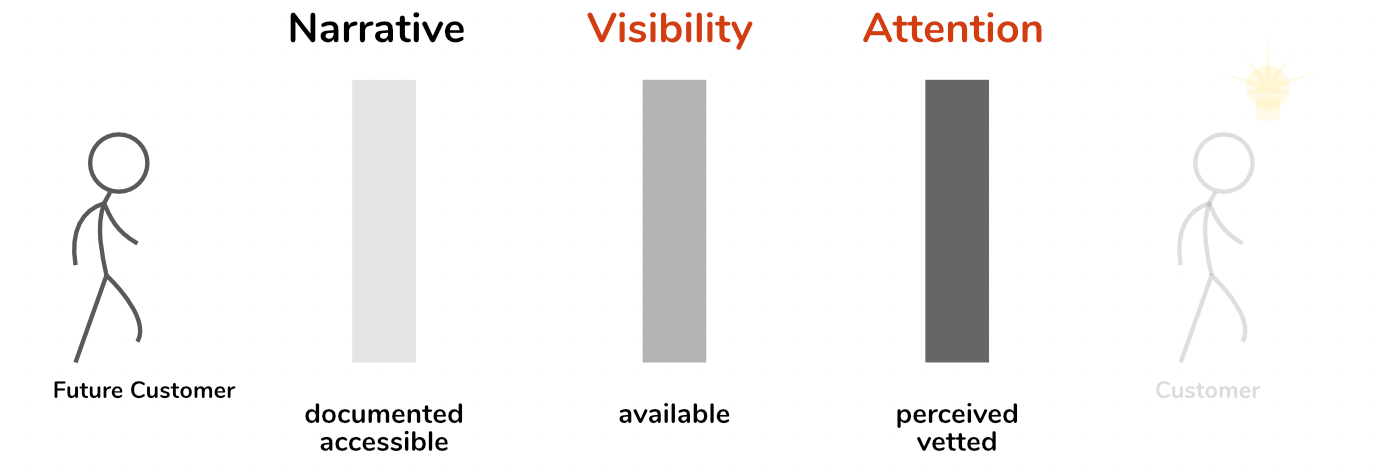
The mechanics of information spread

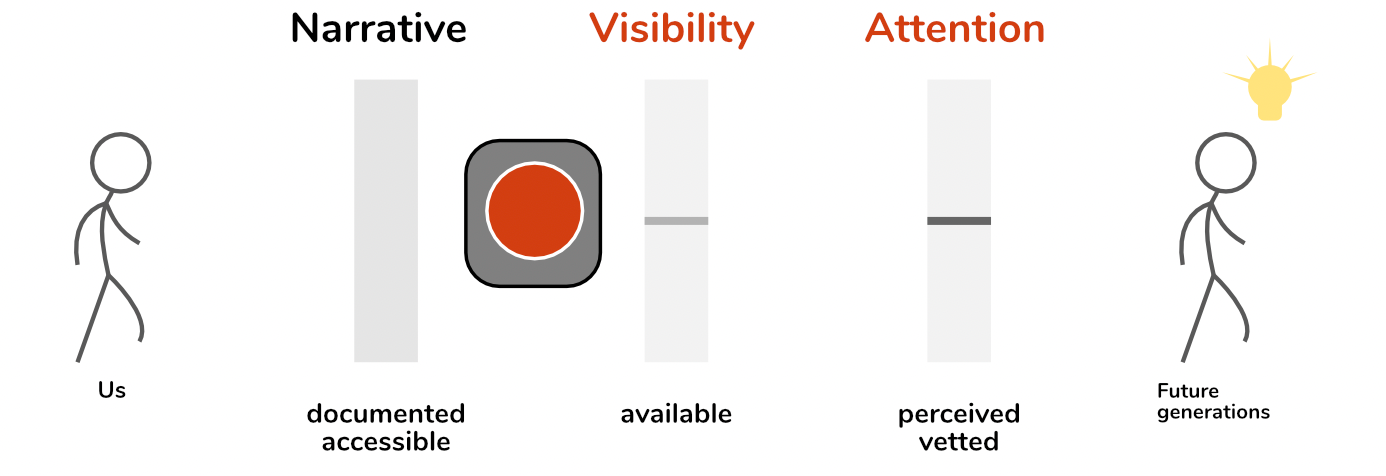
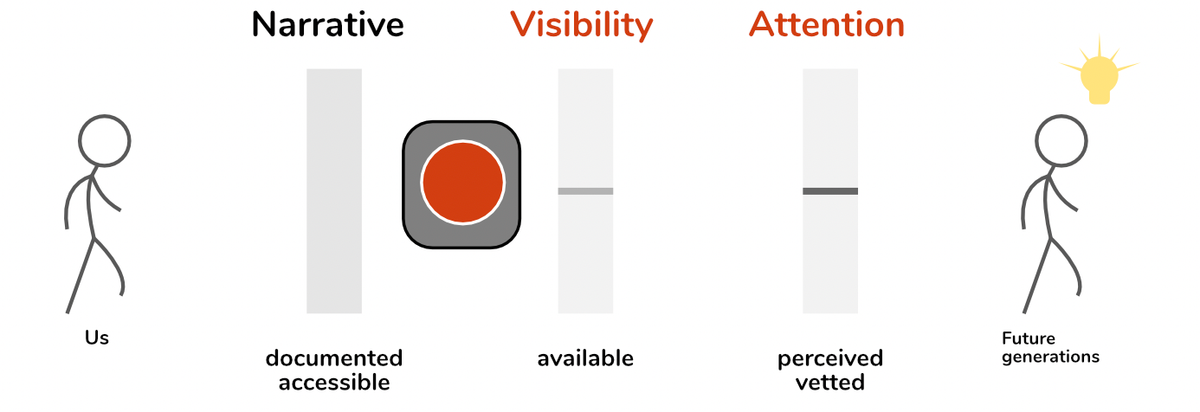
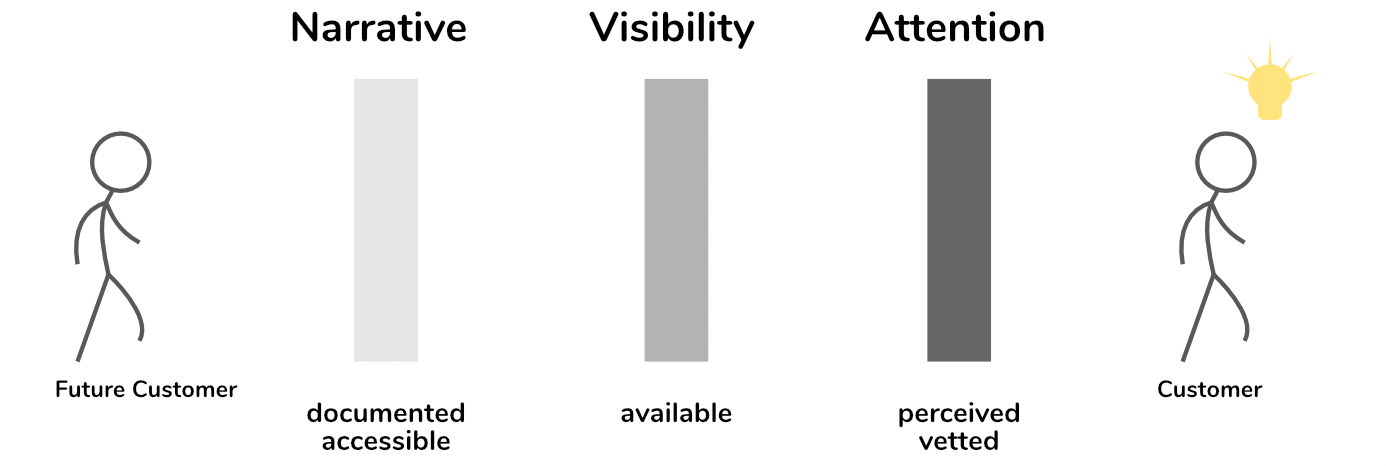
The easiest access point for information is to leverage what someone else has documented; many of us also assume that information is vetted (hint: it’s not a given). It’s NOT that we understand* it, but that we assume we can marry that information with what we do understand and make headway.
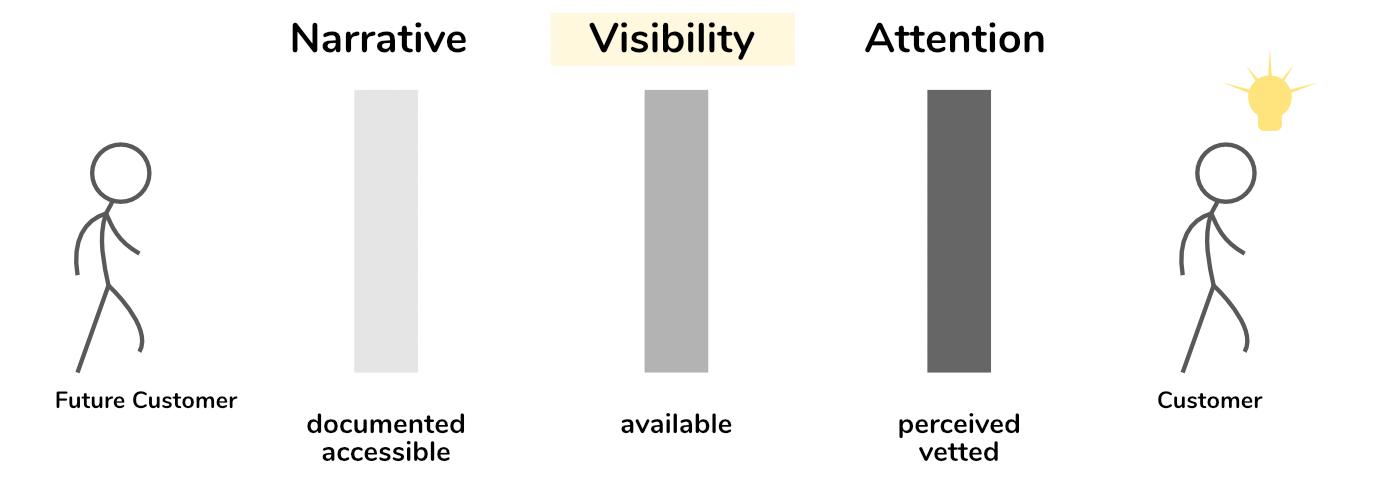
Then it’s a matter of what information *can be* sensed (accessible) *to be potentially* sensed (available / visible) – which does not automatically preclude perception.
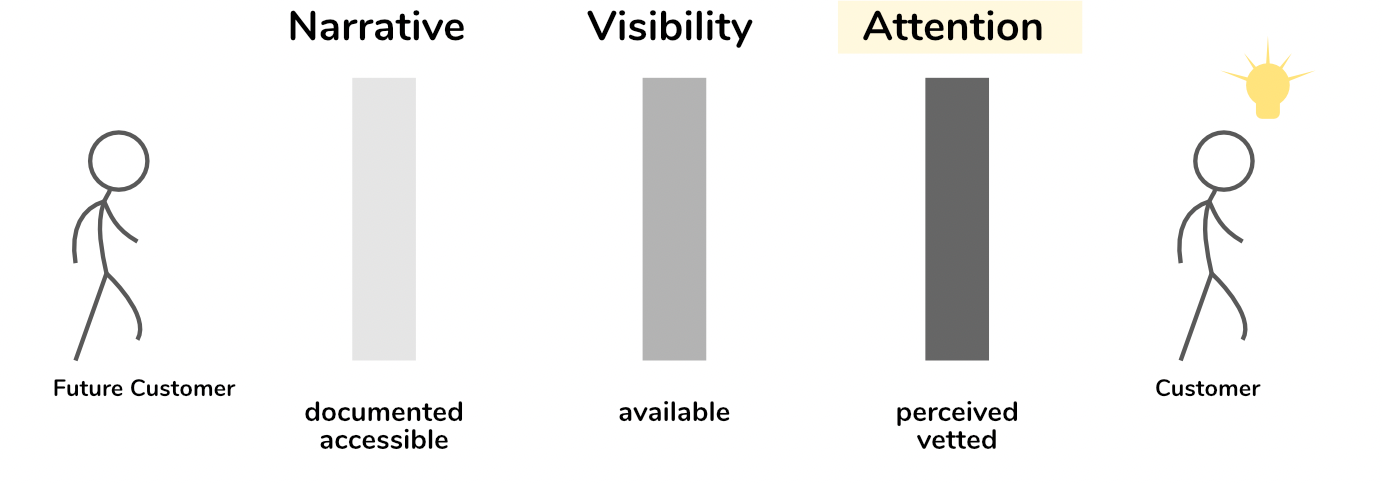
Even after information has hit conscious perception, we have to vet it. Part of vetting is to decide whether the information can be trusted; then, it's deciding if it’s useful to what's at hand.
Sensors and tracking have removed people from some of the mix to documentation. It’s a mixed bag. Automated sensors are more trusted than the physical sense of a person (what is hot?). However, it’s also broken millennia of assumptions around privacy.
For anything that makes it through to documentation, the minds and information literacy of every person involved affects the information trove. Even with sensors and tracking; if someone decides temperature isn’t relevant (or makes a hash of their narrative), it’s not captured.
* What we understand is deeply impacted by what we believe; we all have core precepts that affect most of our lenses. A key one of mine is that humanity rocks, and we have some seriously shitty bad actors. Some others’ have been along the lines of “God is good,” or “everything is explicable with science,” or even “people suck.” Core precepts are as diverse as humanity. ;)
Marketing combines a couple spots, but it’s still information spread
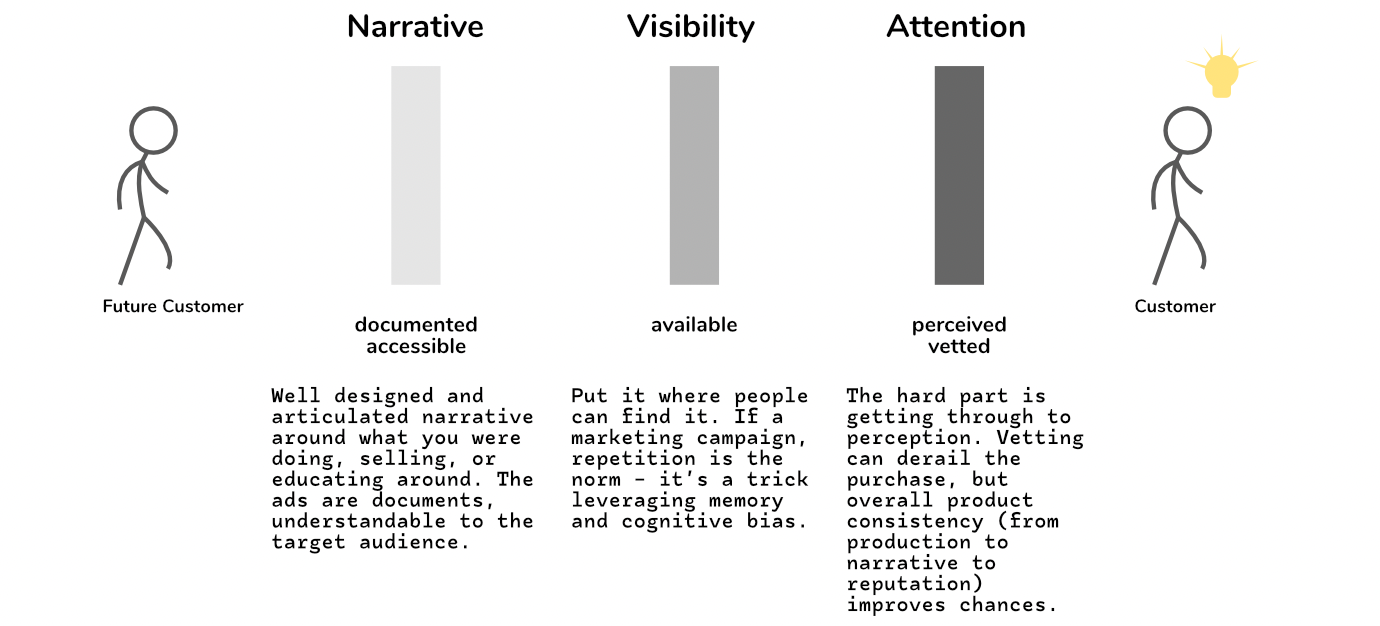
The flow is psychological
The nephew of Sigmund Freud convinced business to leverage psychological manipulation as a way to sell products.* Marketing has been a refined psychological game since then. Narrative was the crux of the game.
Information has always been able to skew our decisions. Always.
Narrative is a highly workable lever.
Narrative is also intrinsically human. We’ve been telling stories as long we’ve had rituals, and there is evidence of rituals since even before we were clearly homo sapiens.**
* Curtis, Adam. 2009. The century of the self. Wyandotte, MI: BigD Productions.
** Mannucci, Mark. 2023. Unknown: Cave of Bones. Netflix.
Visibility evolved
In the early days of marketing, visibility was a matter of physical space, which is finite. TV’s changed the key metrics to time, which is still finite. A good narrative would stick quickly, but both formats also leveraged repetition and building cognitive bias to create an increased probability for a customer to decide a product was relevant enough to buy.
With the advent of the internet neither material nor time were a constraining factor. Businesses started making bets and flooding the zones, looking for ROI. Hello, spam. Marketing became at least in part a numbers game. Flood the systems until recognition kicked in and enough people tipped over into customers.
People freaking hate spam
Instead of creating some kind of individually controlled medium where bad behavior became business poison, it morphed into a narcissistic loophole. At the simple end, businesses stick to the letter of the law by making a new marketing list for each campaign, with an ‘internal process’ that made it impossible to remove contact info (even the Trump administration is doing this). At the extreme, some businesses hired a third party to avoid any legal fallout. The numbers game could continue: you will give me enough visibility to get the attention and customers I demand.
As the ROI decreased, they flooded more to get the ever-dwindling % to reach the quantity of returns they were aiming for.
Then business started pre-selecting for attention
The average person tells stories all the time, but not necessarily good stories. The narratives didn’t stick. But that was also because attention was already on what the person was looking for.
The very first step to putting ads where attention was already adjacent was someone buying a sales list from another company that had some overlap, and then spam. But spamming became a known issue, and the sales lists with some demographics traits were {chef’s kiss}. It escalated from there, until we now have data brokers designing what information makes someone susceptible to what narrative, with the numbers being a matter of finding traction with that one person.* It’s not only email and social media, but shared advertising routes that follow us around the internet.
Social media also provided the richest behavioral data.
* Amer, K. (2019). The Great Hack. Netflix.
LLMs broke the numbers game
No human mind can beat LLMs in terms of sheer numbers. AI slop is overwhelming visibility and attention.
Visibility was always capped by time. People simply do not have enough time to see every product’s advertising in the way marketing works now. When that time is overwhelmed by slop, visibility reduces dramatically.
Attention was always a finite resource from the individual’s standpoint. It was business that decided to ignore that cap – to make people suffer for the sake of potential profit. Part of what LLM’s are doing is forcing business to concede there’s an attention cap, if only because it’s been dramatically exceeded with slop.
LLMs are poisoning information
The people using LLMs to create slop seem to believe deeply that a million monkeys at a million typewriters will eventually produce Shakespeare – it’s just a matter of time. So the assumption is that LLMs will overwhelm the narrative game.
What’s really happening is that they are dissolving the last vestiges of truth in marketing, with exquisitely rancid hallucinations placed with utter confidence.
More likely, an LLM will eventually fold in broad tracking numbers to see what narratives are finding traction and overwhelm the source – starving the artist to make a quick buck. When the next Shakespeare arises, they’ll be drowned out before their name can be associated with the narrative. It’s already happening with some visual artists.
Finding opportunity in what LLMs broke
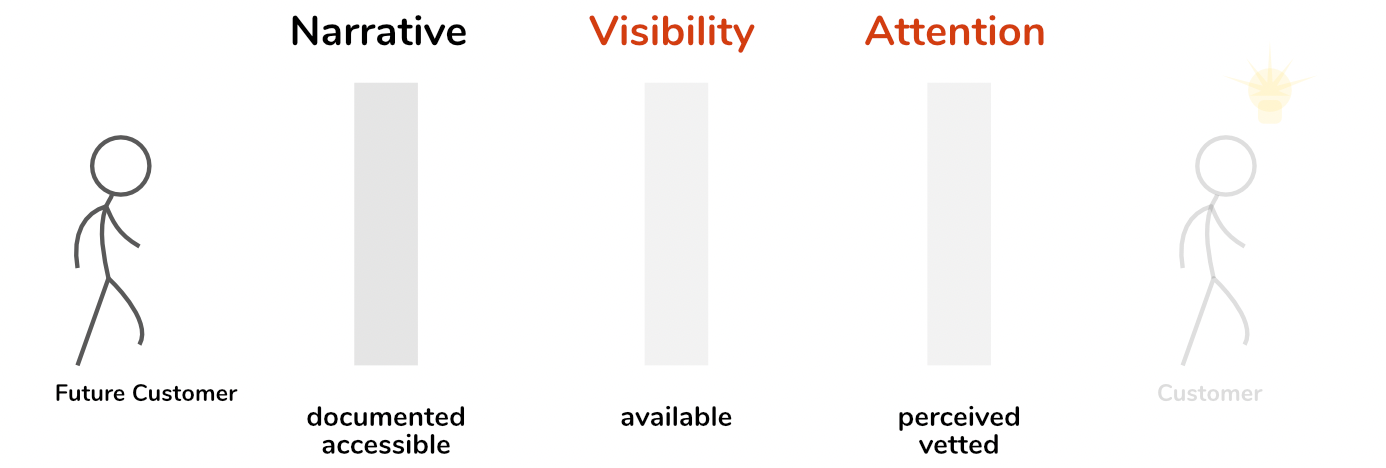
So the point is finally conceded: people only have so much time to ingest visibility, and so much attention. How does business get that attention when there’s so much dross that nothing is getting traction?
In the EU with GDPR outlining data privacy, there’s a resurgence of narrative, often called “effective advertising”. They are betting on a facet of humanity doing work with skill and understanding.
In the US on social media and in search engines, the platform is deciding for us. Both versions want LLM’s use to increase. They want the narrative to go through them, supported by the data-brokered bets for attention already in play.
Both of these assume there’s no fundamental change to the underlying process of marketing – a heightening “yes, and” instead of a pivot.
Increasing visibility
What social media platforms do is present our eyes for information spread – whether it’s marketing, politics, news, professional growth, or friends/family. Honestly, it always has been.
For the platform to retain advertising income, they need to make sure they decide what gets through.
They are in the platform game to make money, not to provide social good. They can’t care why we’re on the platform – our personal narrative means nothing other than some behavioral data to provide potential salability. What matters to the platform is that they have eyes, and people/businesses who still believe those eyes are worth pursuing.
For a good chunk of time, that meant upping the visibility of paying clients. Fold in more ads, trust in the social connections to keep people’s eyes-on as the ads and placed content got deeper.
Numbers are still part of the game
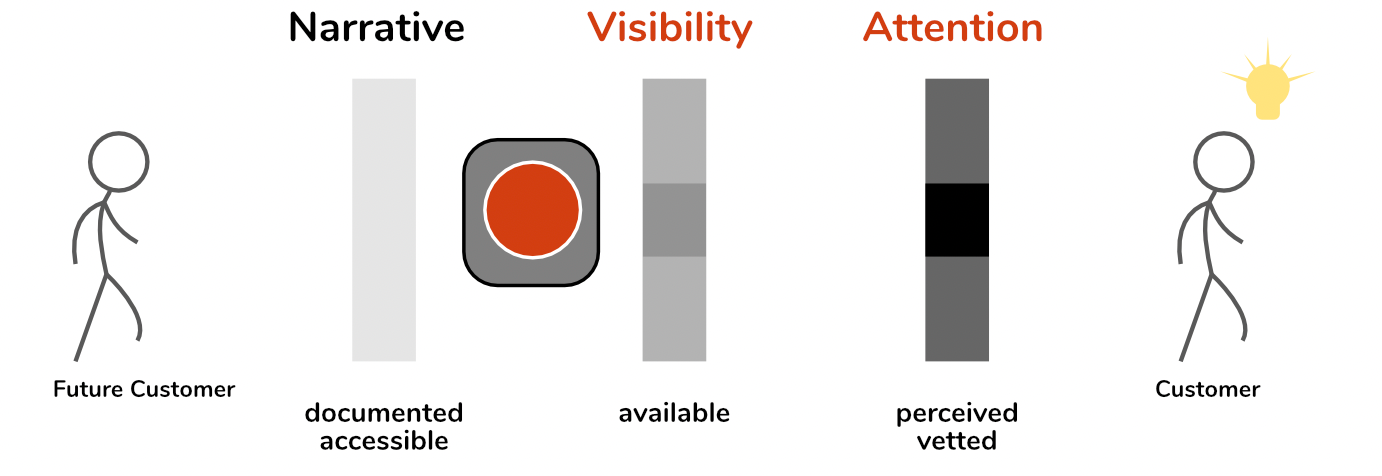
If the numbers get too big, like if LLM’s just keep increasing slop narrative construction, attention breaks, no matter how curious or connected people are. The platform has to reduce in kind. The end-state quantity is stable, the percentage diminishes – just like ROI for marketing email.
The platform has to reduce the impressions of the content that originally kept the eyes focused in order to make room for what pays them. I think this is what we’re seeing on LinkedIn with it’s reduced impressions and cognitively dissonant feeds.
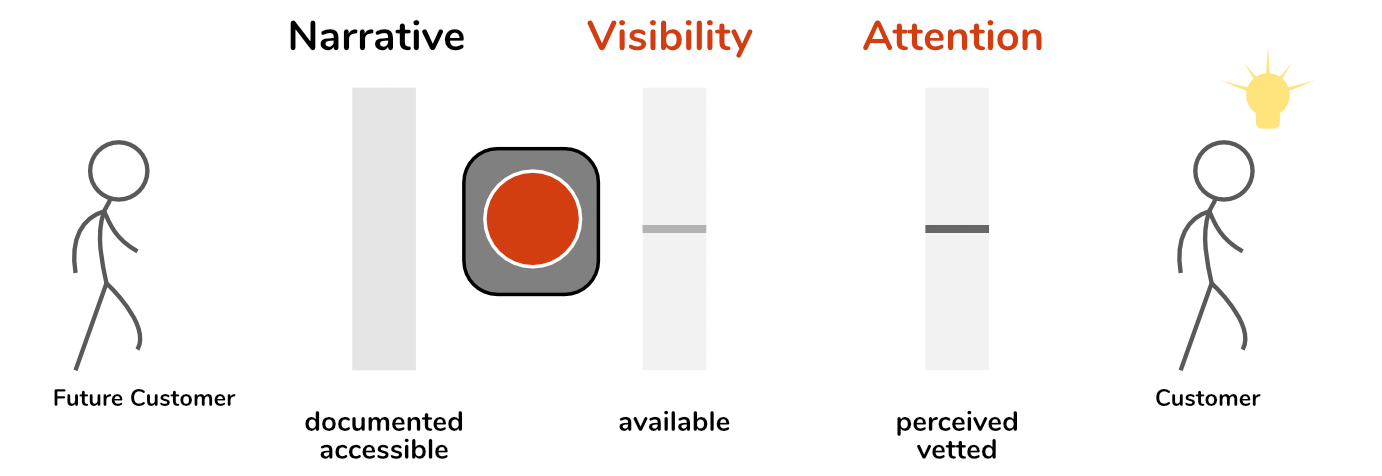
The platforms are in the business of attention, which was hoped to be limitless but is now known to be capped. The marketing model has proven valuable in repetition. But repetition is limited because of the numbers LLM slop has created; and narrative is nearly moot because of LLM slop. An information bet has to be made.
The information bet
- If human attention is finite…
- If numbers (thanks to bots and slop) are infinite…
- If the access to eyes is prioritized and promised as the profit center…
- If bots and slop are part of the platform’s wider financial bet…
- If profit is a never-ending reach, every hour of every day…
The platform has to make an information bet, for the sake of ascendency. It would make sense for it to leverage (bias-filled) history; to track the trends of the hour; and to push for self-fulfilling narrative, like AI hype. It would make sense to constrain anything that doesn’t fulfill those three simplified priorities. They push for sales; but, pay close attention to the language and the impressions is based on an easing of their defined priorities, not a removal of them. They are betting on wishes to improve sales.
People – our lives, understanding, and happiness – are put aside for the interests of data that someone has decided is profitable (remember documentation from the first page – what is hot? Is it relevant?).
Social media wanted our eyes
It was not built to connect a rich and deep society of happy people. Happy people are harder to sell to. Even when Facebook was a college room project, it was about selling the idea that female classmates were objectified, gettable, and dismissible.
- If visibility and attention are now small percentage of the whole…
- And the platform has bet heavily on LLM’s, so can’t constrain LLM’s…
- And profit is the single most important motivating factor for everyone, with big business seemingly deciding There Can Be Only One*?
Do the non-asshole people/businesses just…die off?
Do we let the platforms decide what’s viable for our futures – authority over all of us?
Do we push for change? Build for change?
Does society turn away from social media entirely, in an effort for society to be decided by all the incumbents?
Do we surprise each other with something out of left field?
* Yes, this is a nod to Highlander
Marketing is the lens, but information is the important bit
Information is everything. We don’t make a single decision without information, and we don’t behave or act until we make a decision – no matter how intuitively/subconsciously it was done.
The truncation of good, viable, non-hallucinatory and non-authority-controlled information is a marketing problem. It’s also a hiring problem, an economic problem, governing problem, a science problem, an interpersonal relationship problem, and a society problem.
We’re going to be experimenting in the coming months/years. The question isn’t what we do; amongst our totality, someone is going to try everything. The question is which experiments pull in the gravity of society. If we all just follow where the crowd seems to be going, that red lens decides everything for a long time; it’s already spinning out a narrative of inevitability.
It’s worth making your own decision, and voting with your behaviors and actions, knowingly, for the society you want future generations growing up in.