Information as a potion to cognition

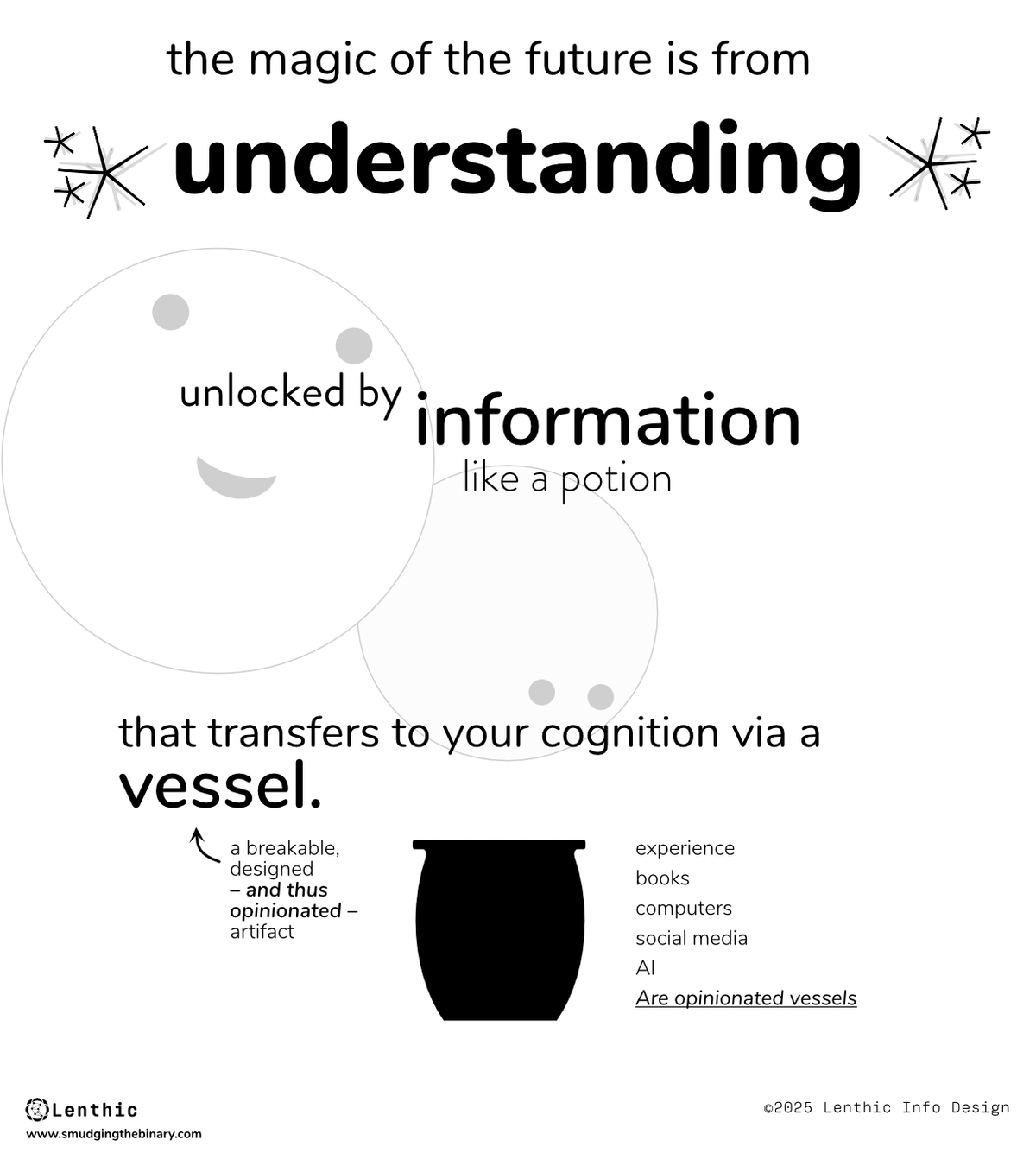
All our everyday things that would have seemed magical to someone 200 years ago came from understanding. Cars, phones, computers – they're all things we figured out. The information was around us, but we had to get the right mix involved before we could see our way to the magic.
How do we start fixing our ongoing disintegration of information? It breaks my heart. It's been going on for over a decade, it's getting faster, and it has tendrils into everything and everyone I care about. And yet: it's information. Information has always been how I got myself out of pickles. The first step in information architecture is always orientation.
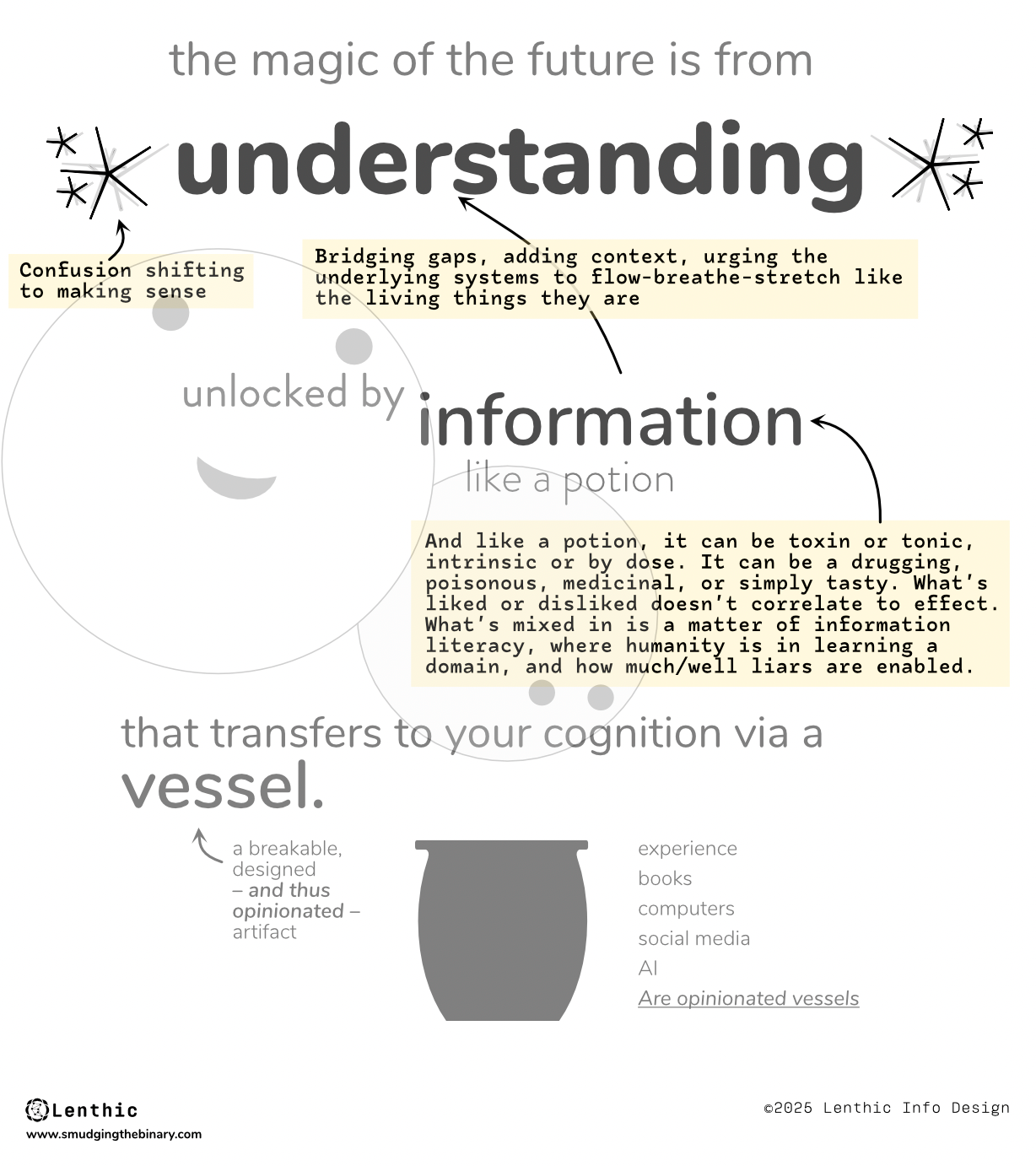
Information is the inception point of understanding, not the end. With information, poking around to see what happens with it, and checking in with others to find out what they sensed, we start making sense of the world. That sense-making is the first whiff of understanding. We make sense of things to be able to more freely navigate to what we're looking for – whether it's more information, a place, a concept, a build, an outcome, change, etc.
The information we use to get to our understanding is incredibly important. Our information builds our internal model of the world. Skew it, and it skews everything. Focus on wishes instead of reality, and the world feels wrong --dissonant, off-kilter, like there's chimeric animal-people always just barely in of the corner of your eye, skittering away when you turn to focus on them. Information and people are inextricably intertwingled.
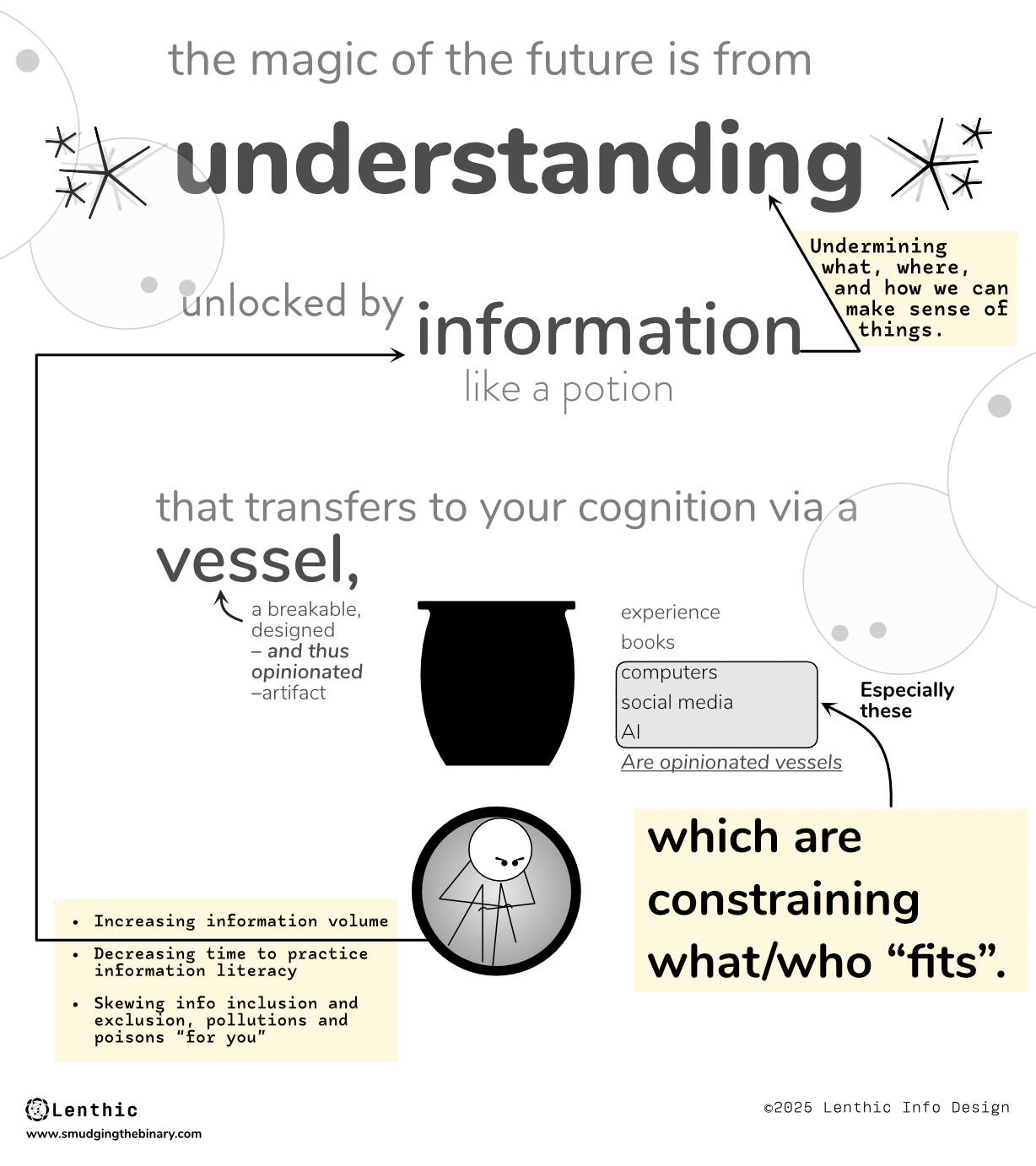
The mechanics and models for information literacy haven't significantly changed in the past 50 years. What has changed is the vessel. We've understood for millennia that experience is a double-edged sword: fundamental to increasing understanding, but also fundamentally skewed because it came with all of that person's entire history and cognition. You learn not to take Bob at face value, but ask deeper questions to get to the good stuff. We grew to understand the same with books.
We have a myth that digital information stores are different. That somehow, some way, human influence got stripped out during the build. Computers. Digitized information, searching, social media, and now AI are somehow all agnostic. But: people decided what things were called (taxonomy) and what characteristics were relevant (metadata), what would spark bubbling them up (algorithms), and what information would be readily available (often little, because "simplify the complex" has become a mantra). Under that, people decided what would even be documented to be shared – including Bob, with no way to ask questions and given the same relevance as Carl Sagan. So while digitized information is vasty, and the memory is less fungible than Dementia Dorene, it's still reflecting people.
There are many threads that went into this, but the meditation here is the information itself. Not only what and how it's contained, but increasing who it will see to share what part of the trove.
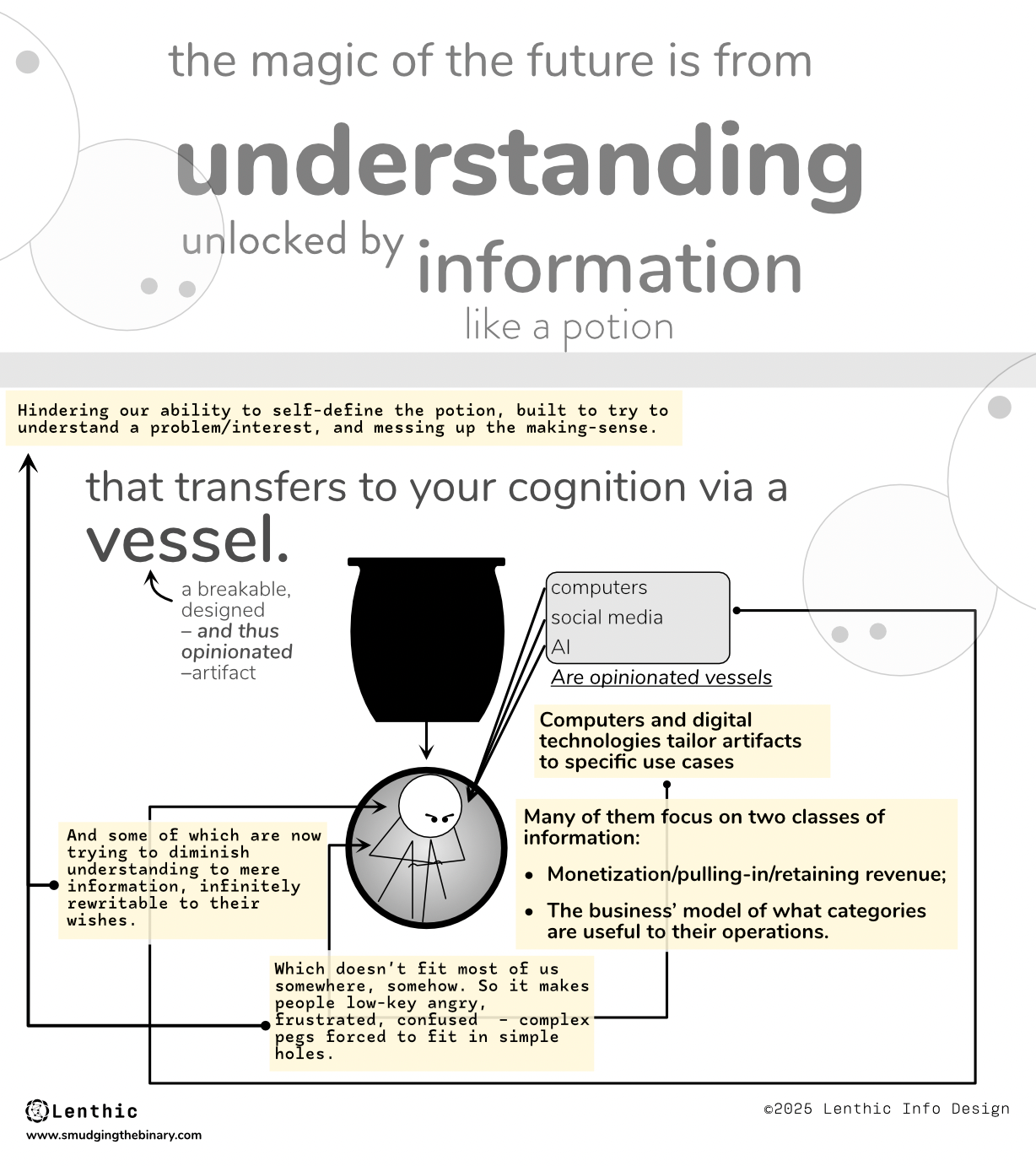
When information disintegrates, our ability to understand our world and cosmos disintegrates. The most strident information literacy won't help us if we can't directly spelunk in information to build towards our particular understanding – because sometimes Bob has a nugget of useful truth.
Part of what happens when there's a binary choice is that people filling in the choice will pick what's closest to their narrative. At the extreme misuse, they might gnaw at it and grow increasingly frustrated about it for days or weeks – like how you wanted to not pay the cable bill when cable had been not working for months, but you couldn't get through to customer service until you paid your cable bill.
Meanwhile, the people that designed the binary choice are seeing what they wanted to see (people paying). They pat themselves on the back and tell themselves they understand the world perfectly – look, the metrics say so.
That intent of poorly designed information meeting C-suite expectations is being built on. The belief (which is really an untested hypothesis) is that heightening the current misorientation will transform everything. But remember, information isn't understanding, it's the first blushes to be able to build understanding. If the information is bad, any sense of understanding is confabulated.
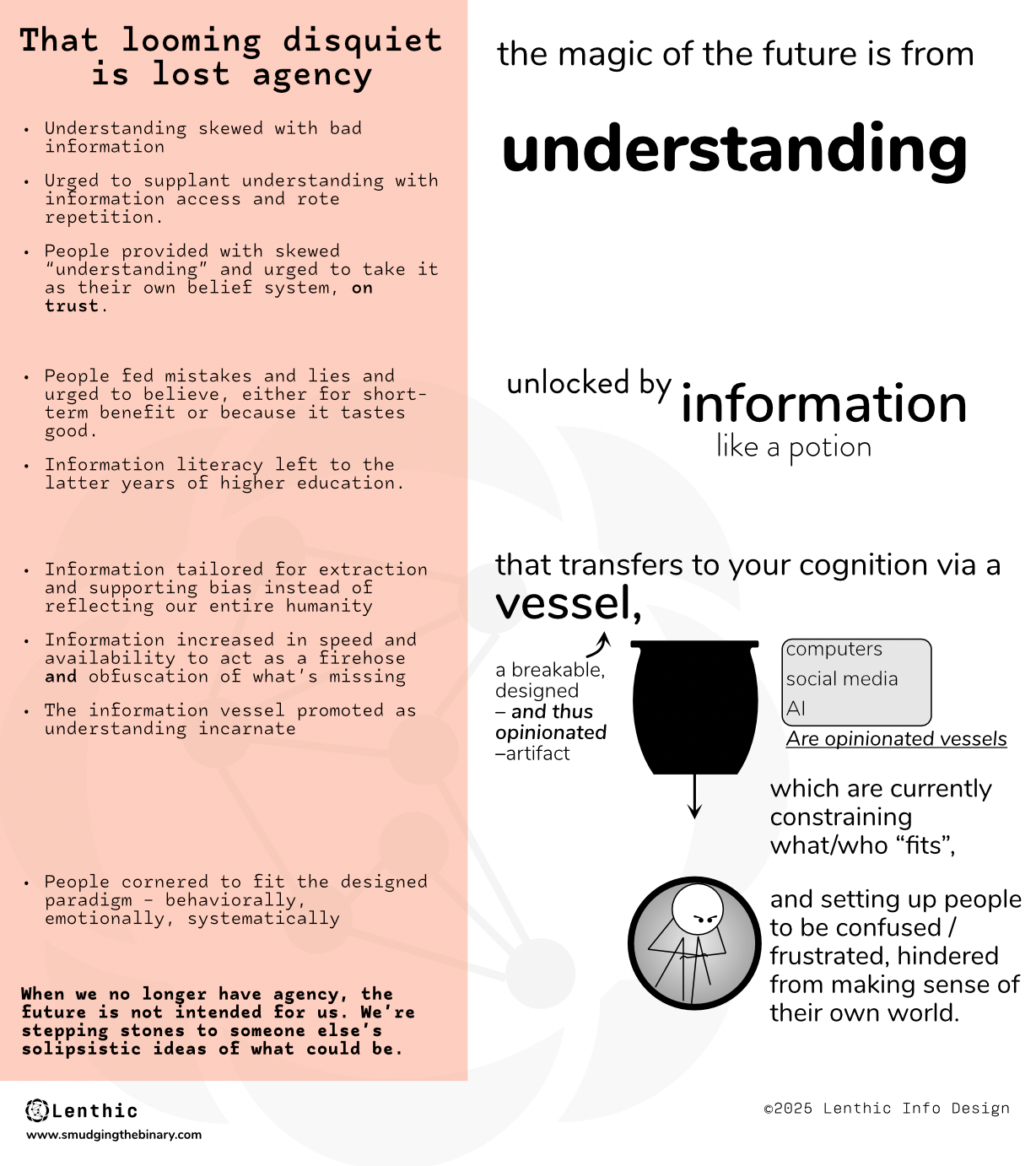
This is second step in information architecture: findability. We have to see the issues to work the problem. If we turn away, if we let it remain unseen because it's uncomfortable to see it, we can't do anything about it.
We are information beings. We use information to navigate our world, our understanding, our information, and even our individual existence.
What we're seeing is information being poisoned at every level: at individual access and documentation, in the vessel, in the potion, and through to understanding and the future it creates.
What happens when information disintegrates is scattered through our history. It's never good. It's always hard for the bulk of humanity, with a few people thinking it's peachy. That difference between hard and peachy is a matter of agency.
Good information gives agency, to those who wish to grab it.
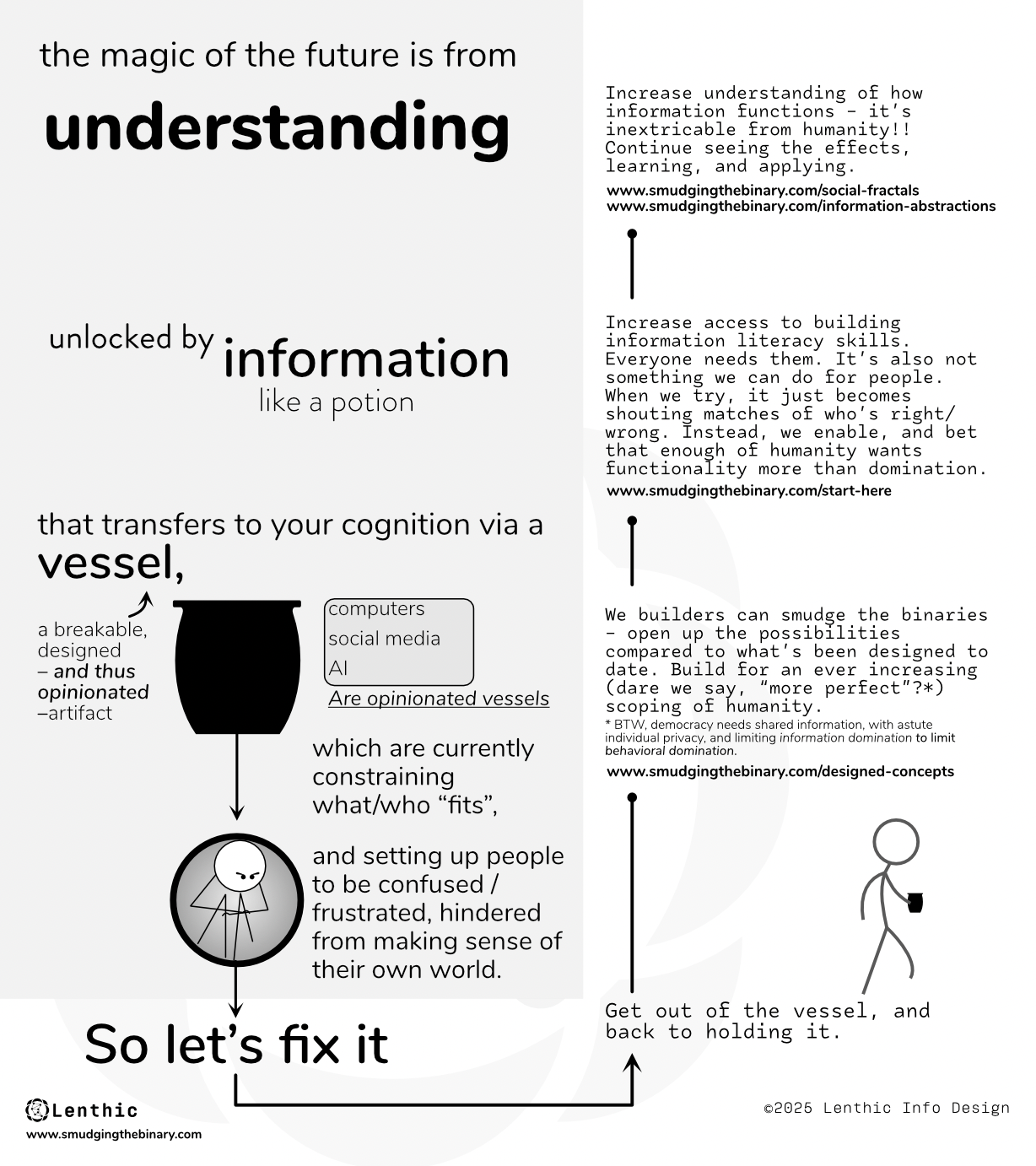
The third step in information architecture is navigation. How do we get from here to there?
The trick to stop the flow of agency out of our lives is to build for it, take it back through practicing information literacy, and understanding the effect of information and how it functions – inextricable intertwingling of information and humanity.
We're information beings. If we poison information, we poison society, cultures, lives. Dysfunctional information is the poison; functional information meshed deeply with reality is the medicine. Not everyone is up for it, and we can't force it. It's a bet, that more of humanity wants function and joy than domination.
If we leave it to happenstance and wishes and the systems already created and tested, we are left to the heightening of the status quo, and that looming disquiet.
Social fractals
Information abstractions
Start here
Designed concepts