Determinism and shifting taxonomy

As more companies move to "determined algorithms", we need to talk about deterministic software. It's been around. We have some people enamored with it, some people angry at it, and lots of tangled meanings. That means that we all have to be careful about packing too much meaning into one little word, and assuming that everyone is on the same page.
As you hear "determin-ed, -ism, -istic" bandied around more, take the time to dig into what they really mean. The more we do, the more we clarify and the more the language might just shift into meaning, instead of becoming a point of confusion and hills to take and die upon.
For now this is going to be my shortest possible take on taxonomy, determinism, and their effects on society. Expect more as more happens in the gestalt.
Taxonomy
"Determin-ed, -ism, -istic" has all the earmarks of it becoming so bogged down with such a multitude of meanings as to become nigh meaningless. It's happened in IT iteratively, with the biggest problems with "UX" and "AI".
There are a few patterns that tend to be the vector forces behind meaning shifts. There are more than this; these are the big ones that are more capable of bubbling up across broader populations.
- We learned something, and that learning is being folded in –
it's the biggest reason we tend to not try to manhandle language until after confusion and crossed wires set in - We devised something, started shortcutting the label as we talked about it to an at-hand word, and so did those people over there –
more likely to happen in silo'd cultures; very common in corporations with behaviorally enforced silos - Someone wants a word to mean what they already understand, and are using it as a buzzword overlayed on their old understanding –
this is what happened most with UX and it's derived subcategories - A set of people want the nuance deprecated so they can ride a wave –
this is what's happening with AI, and is a common marketing tactic (think greenwashing) - A set of people want to co-opt a word with traction to gather the increasing use for themselves, avoid the tarnish the meaning attributes to them, and/or use the ensuing confusion to devise narratives of agreement-by-mismeaning –
this is what the far right does almost continuously now, usually with some overblown anger to push it through/shut people up
Determinism is just recently starting to hit the gestalt in our tooling. I'm not seeing it in just my nerdy spaces, but in some pretty public ones. There are several interpretations forming, and all of them are reaching for the same word.
Part of what's going on is that Sapolsky wrote Determined, and it was very popular in a some circles for a hot minute. Sapolsky did a really good job at stubbing out the intertwingled systems with meaty supporting evidence. It's been out in the world long enough now that people have had a chance to make something with included concepts embedded. He was not the first one to do the work, use the word, etc., but he did make an impact.
There's also a whole subset of peer-reviewed technology research and papers devoted to technology determinism, that I'm just starting to be aware of. I haven't read more than the executive summaries on a few of them, so I can't really speak to them specifically. Those summaries indicated that the social negatives that could be read into parts of Sapolsky's whole where on track as their concern.
Another part of what's going on is that people now need to define code that is not-AI. We can't just call it "code" any more. We learned something, and now we have to have a label for what was previously the assumed totality of what we had been doing.
Determinism
I really do recommend reading the book to anyone with the will and heart. I rarely ask anyone to read anything, and I've asked several people to read Determined. I share books, articles, and pieces all the time with people in my sphere who love to read, but rarely ask with intent to talk about it. I don't agree 100% with his interpretation, but the layered systems that he implicitly stubs out is very much in sync with my own understanding.
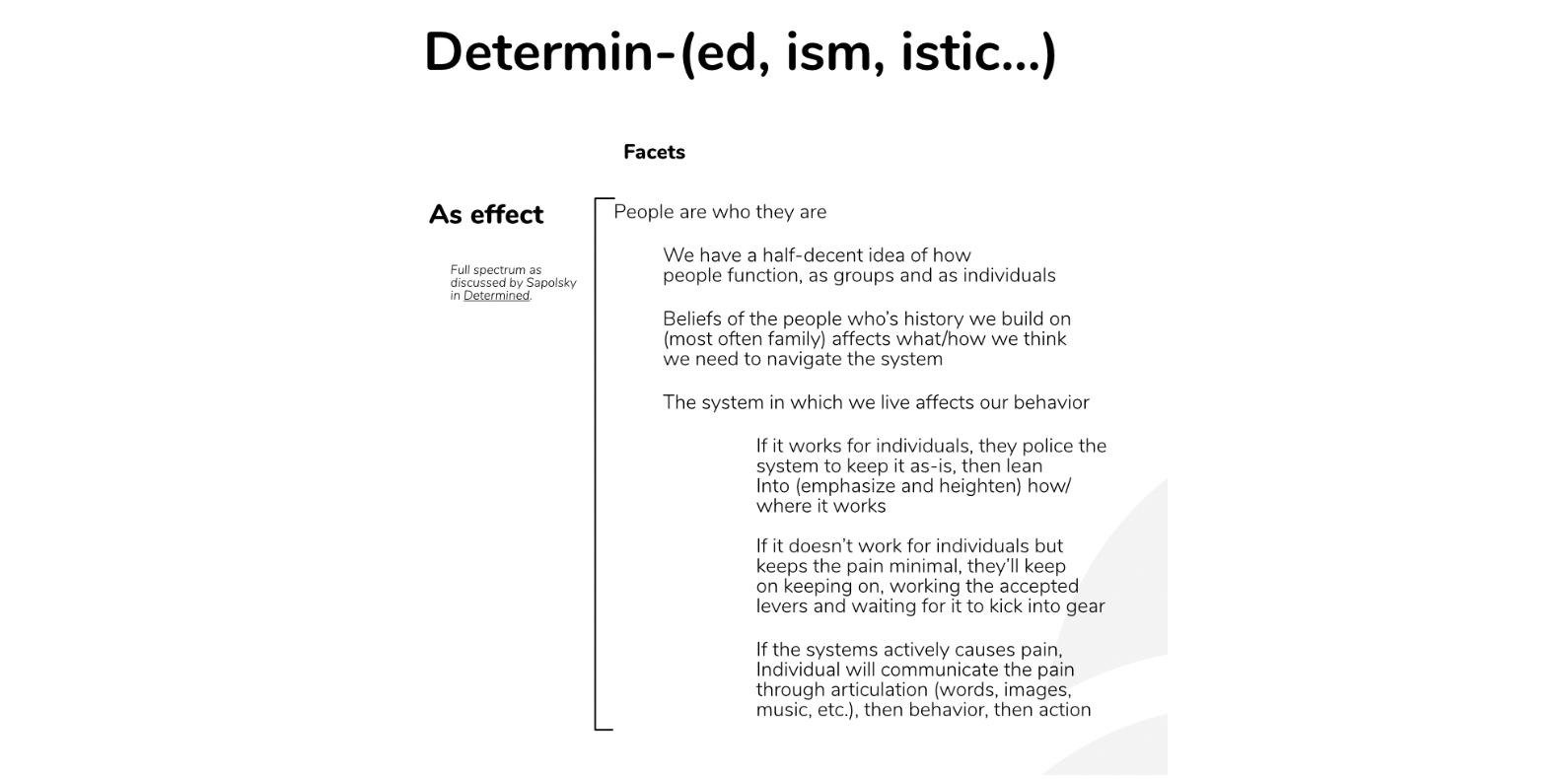
What Sapolsky has done is to implicitly start stubbing out the intertwingled systems. Humanity is not stuck in a dualism of nature/nurture, no more than light is stuck in a dualism of wave/particle. People are both, and probably more.
Where it all gets wiggy is how people interpret that into a fractal expression, whether culture, society, or information tool. There are so many ways that it's being interpreted for use that it's becoming it's own complexity. But there are key ways that it's being used as an excuse for things people have done for a long time.
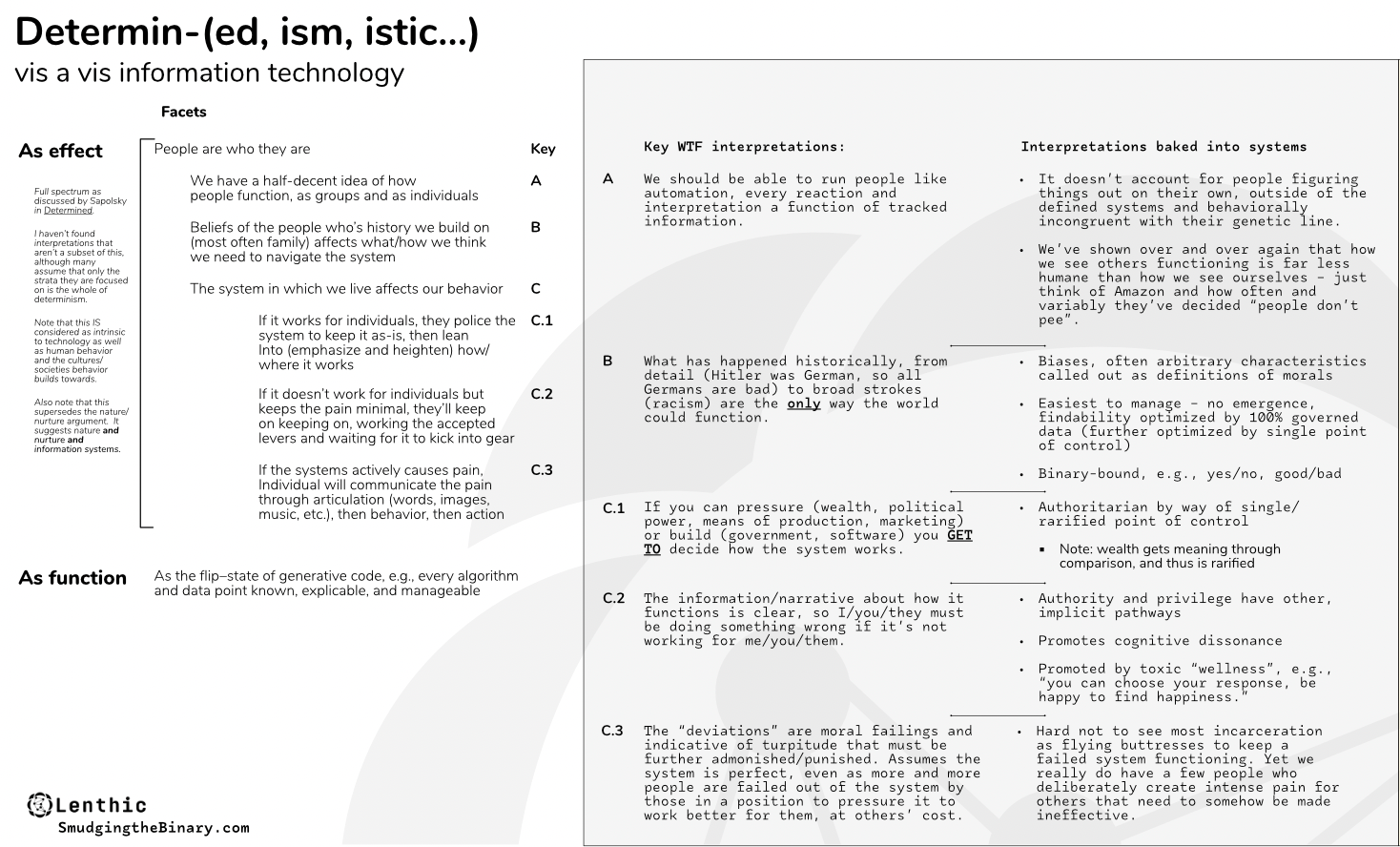
I call them WTF interpretations, because: WTF people. Why are you being usurious assholes and then saying it was anything other than your choice, and every negative downstream outcome is "their choice". XYZ (survival, god, profit, etc., and now determinism) made me do it, but you/they had full agency to make a different decision. 🤦
There are more than the following tropes embedded in interpretations to externalize the pain and suffering of others as facets of "just what we're working with here", but these are what are used most often, based on my own fuzzy-memory and decades-long pattern making – so very subjective. The system facet is in bold, the WTF interpretation is in italic.
- Facet A: We have a half-decent idea of how people function, as groups and as individuals
We should be able to run people like automation, every reaction and interpretation a function of tracked information. - Facet B: Beliefs of the people who’s history we build on (most often family) affects what/how we think we need to navigate the system
What has happened historically, from detail-made-characteristic (Hitler was German, so all Germans are bad) to broad strokes (racism) are the only way the world could function. - Facet C.1: If it works for individuals, they police the system to keep it as-is, then lean into (emphasize and heighten) how/where it works
If you can pressure (wealth, political power, means of production, marketing) or build (government, software) you GET TO decide how the system works. - Facet C.2: If it doesn’t work for individuals but keeps the pain minimal, they’ll keep on keeping on, working the accepted levers and waiting for it to kick into gear
The information/narrative about how it functions is clear, so I/you/they must be doing something wrong if it’s not working for me/you/them. - Facet C.3: If the systems actively causes pain, an individual will communicate the pain through articulation (words, images, music, etc.), then behavior, then action
The “deviations” are moral failings and indicative of turpitude that must be further admonished/punished. Assumes the system is perfect, even as more and more people are failed out of the system by those in a position to pressure it to work better for them, at others’ cost.
What I'm seeing right now is an intent to lean into those WTF interpretations. Each one, individually, can be built or seen as a "deterministic" system. When we look at the key WTF interpretations, it really is the basis for so much of our societal woes, so I have sympathy with those who are alarmed at the use.
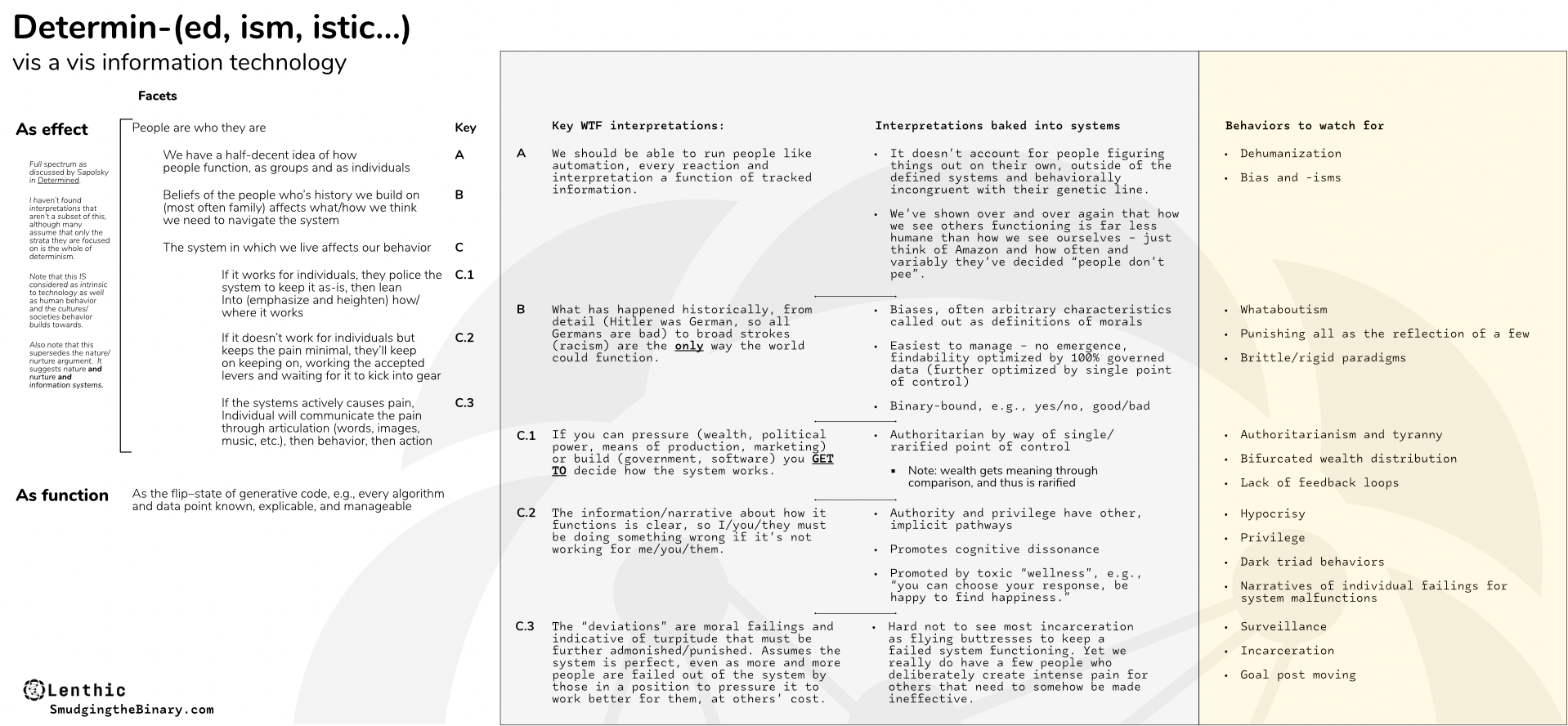
The key stumble is that I think determinism is the whole, not the parts. Leveraging it as silo'ed bits of function leads to confounded wrongness. In my opinion, that's because it's not a function; it's insight. It's often explicable as a lens; it doesn't work as a to-do list without significant information culling. To use determinism as a function means we have to pick and choose who to listen to: the people who want to control everyone else, or the people who don't want to be controlled, or the people who want clear instructions (which reads as "controllable" by those who want to control), or...you get the drift. It's variations and nuance of control, authority, and object (aka dehumanized people). It's used to decide a hierarchy.
Society
The second distinct meaning group listed above – deterministic code as a juxtaposition to generative code – is the easier one to talk about first. There's likely going to be a tendency in the gestalt to default to this definition for when software is called deterministic, because it's clear and involves no sense of ethics to form a lens. I have no personal problem with the word in this context; it's effective and calls out a key characteristic. My worry is that big tech will use this to obfuscate the culture and society aspects of determinism in their builds...mostly because those aspects are already there. Every time you have to accept a statement of use or privacy with the only other option being to lose access to a wanted tool, you're in a deterministic framework (facet C.1).
In many ways, it's easier to sense the negatives when we think about the WTF interpretations of determinism on a societal scale.
The US was drafted as an ongoing experiment. Our constitution was written broadly enough to shift with an emergence that they knew they couldn't imagine. What's happening right now is because Congress had abdicated authority, and SCOTUS is actively supporting the usurpation of control by the executive branch. The system didn't utterly fail; the people who were supposed to embody the system and ensure it's checks and balances did.
When it goes very awry, there are people involved who are intent to get the carrot, and wield the stick, or else. They take every WTF interpretation, and lean in. This is the underlying patterns with nationalism; fascism; white supremacy. It's in corners of the Democratic Party catering to individual wealth building. The whole or a subset is part of the core precepts of every wealth builder. It's embedded in the current social push to adopt LLM's, and a whole slew of marketing and hype in our history.
All these people decided they had the right to determine everyone's place, and set about enacting that model. It's a bullshit model. Not least of which is because they cannot imagine how humanity is going to continue it's emergence except maybe as a heightening of what they've already decided (facet C.1). All of their patterns are intent on putting the whole of society in amber, stuck in place with a system that doesn't work, doesn't sync with the reality of most of our population, doesn't sync with the reality of our planetary boundaries, and can't function in a global society. And they know the last one because they are going around and being a bully: through tariffs, through pushes to change other countries' laws and sovereignty, through pressuring international judges, through military strikes. And they know their vision doesn't sync with reality, and so they are doing their damnedest to remove information that shows that they're outright wrong, lying, or even simply not quite right in an emerging understanding.
Big tech is being as much a bully, too, through (lack of) data privacy, surveillance, LLM adoption pushes, shifting governance rules that moat people into their system with greater trackability, and deceptive design – just to name a few.
There is a flip to this coin. Don't wait for it to fall into a binary, but watch the globe-forming outlines of the whole as it flips through the air.
The outline is right there in determinism. People will be people. We live as the next emergence of what came before, turtles all the way down. And those behavioral histories are built on navigating our systems.
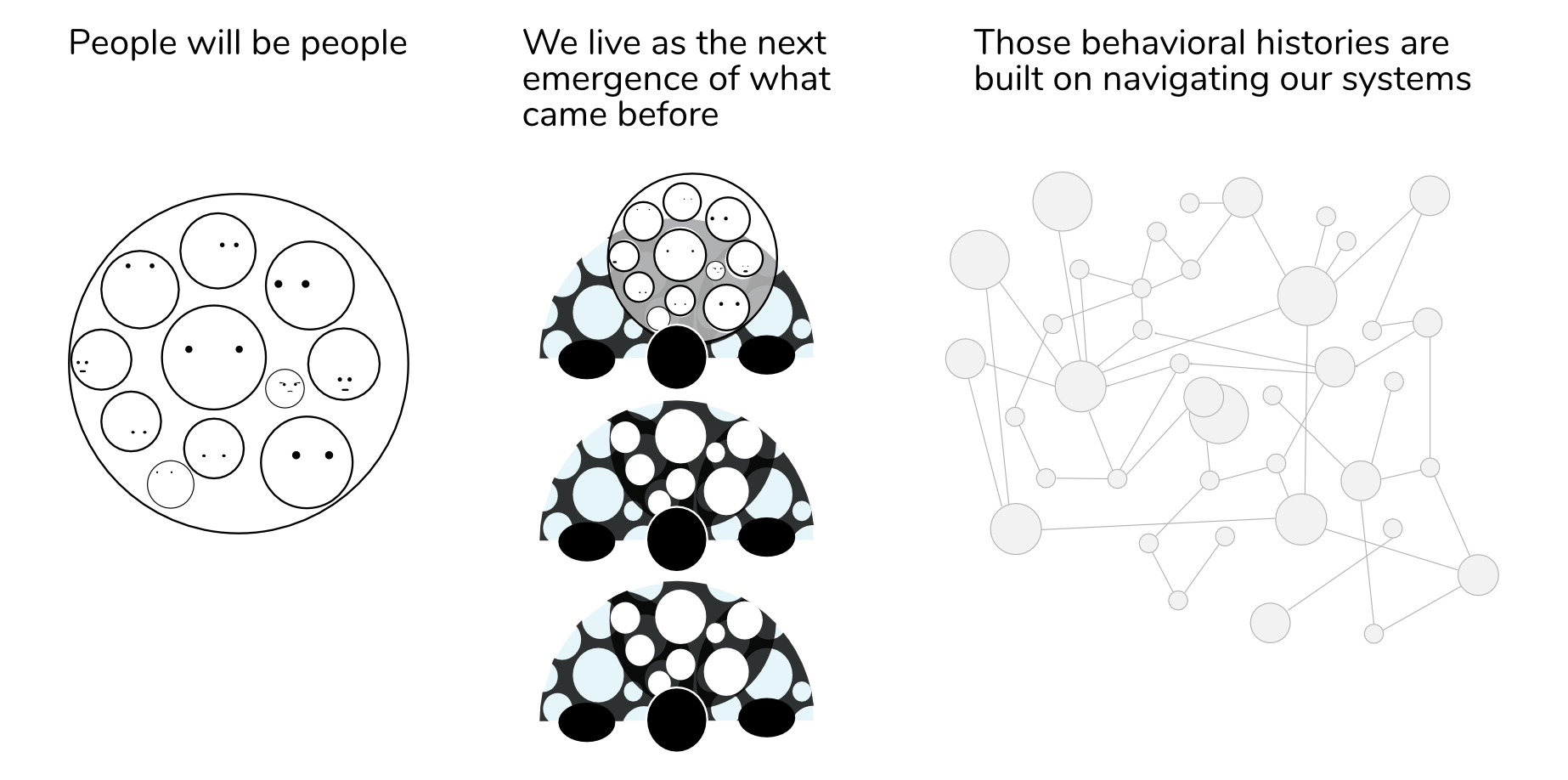
Look afield. Western culture is not the only expression of reasonably long-term functionality.
Ideas of conquest and subsumation are embedded in Western culture, and have destroyed longer-lived cultures and societies. Some still exist, and they are far different from Western culture in terms of interpersonal standards, cultural relationships with their environment, and economic frameworks. What we've been using is not the only solution. Hell, interpersonal standards have shifted dramatically through documented history of Western culture. The Western narrative around ascendency is centered around worthiness, but the action is centered around violence and information destruction – blood and erasure. The same things Nationalists are doing or setting up now in the name of our entire country.
But, people are people. We live as the next emergence of what came before, turtles all the way down. And those behavioral histories are built on navigating our cultural, societal, and environmental systems. Information in our genes, the function of our bodies and physical reactions to the world around us; information in our behavior; information in our culture; and information in our society. And culture and society must live within an environment: our planet cannot be dismissed. The environment keeps rippling out from there – without this sun at this age in this gas mix at this temperature (and countless other things), life as we know it wouldn't have evolved.
If we build all that information on the same essential static structures – the WTF interpretations – they will always eventually oscillate into collapse. The largest flaw is simple: it doesn't include time. Evolution. Emergence. Life does not continue as-is into infinity; you, specifically, are not the same person you were at 5 and 15 – literally, physically, not the same. You also aren't the same emotionally, intellectually, experientially, morally, ethically, professionally...and on and on. Emergence happens in the life we live, yet we can't accept that it happens in our cultures, society, and understanding? We understand such a fleetingly small percentage of the cosmos that thinking we have it so known as to set all of humanity in amber just doesn't make any sense.
If we assume time is relevant, emergence can't be ignored. If we build for emergence, and stick with emergence instead of falling for or else threats, we build for people as people.
Emergence is ongoing (turtles all the way down), continual (language is always shifting), and endless (each of us dies, but our mass epiphanies live on, shifting and building). Emergence becomes the throughline; not a top-down dictation of what-was, who you can be, societal-level gaslighting, and incarceration and surveillance of the many for the comfort of a few.
People may very well be determined aspects of complex information systems – plural systems! We are each of us a bottom-up expression of the vagaries of our implicit and explicit totality, and where that totality ends cannot be dictated from above and actually work.
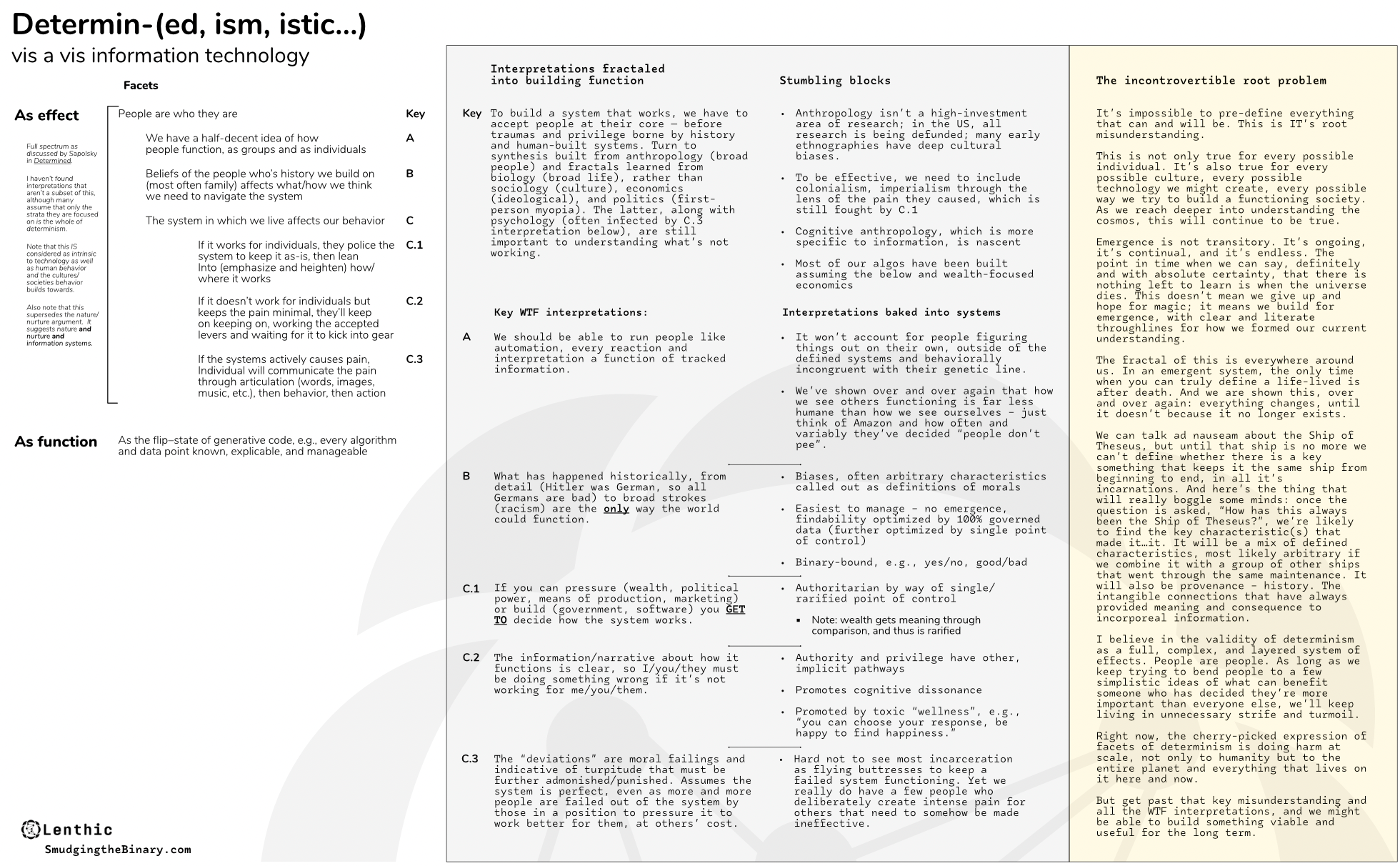
It’s impossible to pre-define everything that can and will be. This is IT’s root misunderstanding.
This is not only true for every possible individual. It’s also true for every possible culture, every possible technology we might create, every possible way we try to build a functioning society. As we reach deeper into understanding the cosmos, this will continue to be true.
Emergence is not transitory. It’s ongoing, it’s continual, and it’s endless. The point in time when we can say, definitely and with absolute certainty, that there is nothing left to learn is when the universe dies. This doesn’t mean we give up and hope for magic; it means we build for emergence, with clear and literate throughlines for how we formed our current understanding.
The fractal of this is everywhere around us. In an emergent system, the only time when you can truly define a life-lived is after death. And we are shown this, over and over again: everything changes, until it doesn’t because it no longer survives.
We can talk ad nauseam about the Ship of Theseus, but until that ship is no more we can’t define whether there is a key something that kept it the same ship from beginning to end, in all it’s incarnations. And here’s the thing that will really boggle some minds: once the question is asked, “How was this always the Ship of Theseus?”, we’re likely to find the key characteristic(s) that made it…it. It will be a mix of defined characteristics, most likely arbitrary if we combine it with a group of other ships that went through the same maintenance. It will also be provenance – history. The intangible connections that have always provided meaning and consequence to incorporeal information.
I believe in the validity of determinism as a complex, layered system of effects. People are people. As long as we keep trying to bend people to a few simplistic ideas of what can benefit someone who has decided they’re more important than everyone else, we’ll keep living in unnecessary strife and turmoil.
Right now, the cherry-picked expression of facets of determinism is doing harm at scale, not only to humanity but to the entire planet and everything that lives on it here and now.
But get past that key misunderstanding and all the WTF interpretations, and we might be able to build something viable and useful for the long term.